Table of Contents
Introduction
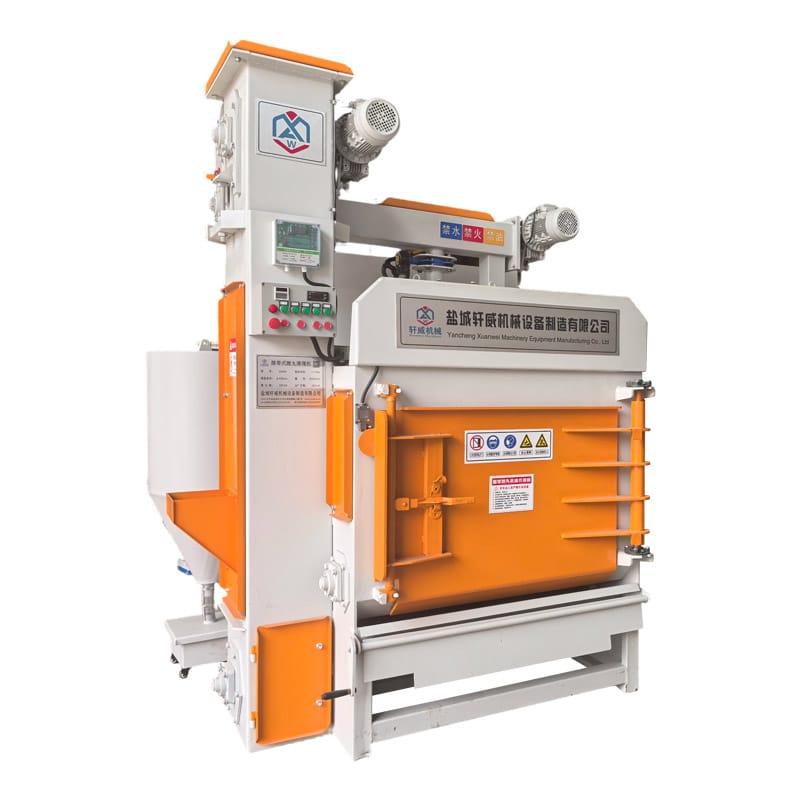
Shot blasting machine specifications provide much more information than machine size and motor power. For industrial users, specifications describe how large a workpiece can be processed, how much material the machine can handle, how aggressively the surface can be treated, how quickly abrasive circulates, and whether the equipment can fit into an existing production process.
However, comparing machines only by a few headline numbers can be misleading. A higher installed power does not automatically mean better cleaning, and a larger chamber does not necessarily mean greater production capacity. Workpiece dimensions, loading weight, blast wheel arrangement, abrasive flow, conveyor speed, dust extraction, and handling method must be evaluated together.
Understanding the most important shot blasting machine specifications helps manufacturers compare equipment according to real production requirements rather than isolated technical figures. This guide explains the key parameters that should be reviewed before selecting or configuring industrial shot blasting equipment.
Why Shot Blasting Machine Specifications Matter
The purpose of a technical specification is to connect equipment capability with the workpiece and production target.
A manufacturer processing small castings needs different specifications from a steel fabrication plant cleaning long beams. Likewise, a company operating batch production will evaluate capacity differently from a facility using a continuous pass-through line.
Important specifications generally fall into several groups:
| Specification Group | Typical Parameters | Main Purpose |
|---|---|---|
| Workpiece capacity | Size, weight, batch load | Determines what the machine can process |
| Blast system | Wheel quantity, motor power, abrasive flow | Determines blasting capability |
| Handling system | Belt size, hook load, conveyor speed | Determines workpiece movement |
| Abrasive system | Media capacity, circulation rate | Supports stable blasting |
| Dust extraction | Air volume, filtration arrangement | Controls generated dust |
| Machine dimensions | Length, width, height | Determines installation requirements |
| Electrical system | Installed power, voltage | Defines power requirements |
| Production capacity | Batch output or throughput | Relates equipment to production demand |
These values should not be reviewed independently because changes in one area often affect the others.
Maximum Workpiece Dimensions
Workpiece dimensions are among the first shot blasting machine specifications that should be confirmed.
The machine must provide sufficient working space for the largest component expected in production. Length, width, height, and diameter can all matter depending on the equipment type.
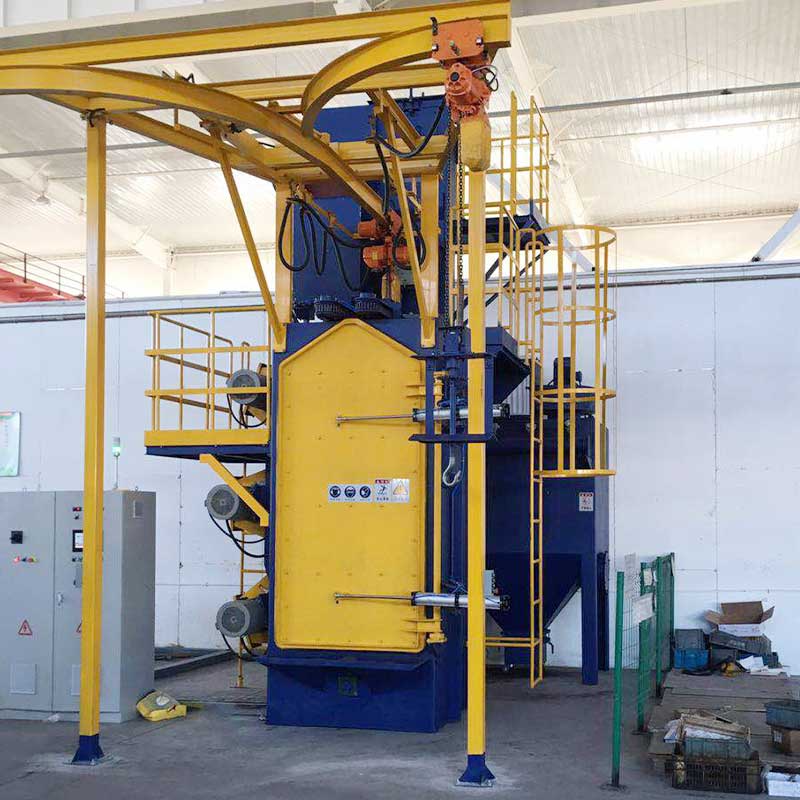
For a hook machine, the important dimensions include not only the chamber size but also the rotational clearance around the suspended component. A workpiece may technically fit through the door but still be too large to rotate effectively during blasting.
For roller conveyor equipment, the width and height of the passage opening determine the maximum cross-section that can enter the machine.
Crawler equipment uses a different approach because components are processed in batches. Individual workpiece dimensions must allow the parts to tumble freely without becoming trapped or interfering with crawler movement.
Providing accurate maximum and minimum component dimensions is therefore more useful than simply requesting a “large” or “small” shot blasting machine.
Individual Workpiece Weight
The maximum weight of a single workpiece is another critical specification.
In hook-type equipment, the hook, lifting structure, rotation system, and chamber support must all accommodate the required load. The allowable weight should include the actual component and any tooling or fixtures used during processing.
In conveyor machines, roller load capacity and conveyor drive design affect the maximum weight that can move through the machine safely.
For crawler equipment, individual part weight is important because heavy components repeatedly contact the moving belt and other workpieces.
The correct machine should therefore be selected according to both workpiece dimensions and weight. Two parts of similar physical size may require completely different handling systems if their masses differ significantly.
Batch Loading Capacity
For batch equipment, total loading capacity can be more important than the weight of an individual component.
A crawler machine may be designed to process a defined total weight during each blasting cycle. This value represents the combined load rather than the maximum weight of one part.
Loading beyond the effective capacity can restrict component movement. When parts cannot tumble properly, some surfaces may receive insufficient abrasive exposure.
Underloading can also affect operating efficiency if the machine is consistently used far below its designed capacity.
When evaluating a crawler-type shot blasting machine, manufacturers should therefore consider typical batch weight, individual component dimensions, part quantity per batch, and whether the components can move freely together.
Hook Loading Capacity
Hook capacity is a defining parameter for suspended-workpiece equipment.
A hook-type shot blasting machine may process large castings, fabricated structures, or irregular components that should not tumble against one another.
The hook rating must correspond to the heaviest production load, but weight alone is not enough. Workpiece center of gravity, suspension method, rotational balance, and overall dimensions should also be considered.
If a component is poorly balanced on the hook, rotation may become unstable even when total weight remains below the nominal capacity.
For this reason, machine selection should be based on representative workpiece drawings and loading arrangements rather than hook capacity alone.
Blast Wheel Quantity
The number of blast wheels is one of the most visible shot blasting machine specifications, but more wheels do not automatically mean better cleaning.
Blast wheels must be positioned so that their abrasive patterns reach the surfaces requiring treatment. A machine with fewer correctly positioned wheels can sometimes provide better coverage than a machine with additional wheels directed inefficiently.
Crawler machines may rely on workpiece tumbling to repeatedly expose different surfaces to one or more blast zones.
Pass-through systems typically require several wheels positioned above, below, or beside the material path because plates, beams, and profiles maintain a more predictable orientation.
The appropriate wheel quantity should therefore be determined by workpiece geometry, machine layout, required surface coverage, and production speed.
Blast Wheel Motor Power
Blast wheel motor power indicates the electrical power available to drive abrasive acceleration.
Higher motor power can support greater blasting capability, but it should never be evaluated independently from wheel design, abrasive flow, media size, workpiece speed, and blast pattern.
Installing a high-powered wheel does not solve poor abrasive coverage. If the blast pattern misses part of the workpiece, increasing power can simply increase wear in areas already receiving sufficient impact.
Motor power is therefore best understood as one part of the blasting system.
When comparing machines, users should evaluate wheel power together with the number of wheels, abrasive flow per wheel, wheel position, and intended throughput.
Abrasive Flow Rate
Abrasive flow describes how much blasting media is supplied to the blast wheels during operation.
This parameter directly influences how many abrasive particles reach the workpiece over a given period.
Too little media may reduce cleaning intensity and increase treatment time. Excessive abrasive flow can overload the wheel or recovery system without producing an equivalent improvement in surface condition.
Abrasive flow should be matched to blast wheel capacity and the required surface treatment.
Because the media is normally recovered and reused, the recovery conveyor, bucket elevator, separator, and storage hopper must also be capable of handling the circulation volume.
The underlying process belongs to the broader category of abrasive blasting, where abrasive particles are propelled against a surface for cleaning or modification.
Blast Wheel Speed
Blast wheel rotational speed influences abrasive velocity and therefore the energy delivered to the workpiece.
This does not mean that the highest possible wheel speed is always preferable.
The required impact intensity depends on workpiece material, abrasive characteristics, surface contamination, and target finish. Excessive blasting intensity can increase wear on both the workpiece and machine components.
Stable performance requires a balance between wheel speed, media flow, exposure time, and abrasive size.
If surface cleaning becomes inconsistent, wheel speed should not be adjusted before other possible causes—such as worn blades, incorrect abrasive flow, or poor workpiece movement—are checked.
Processing Capacity
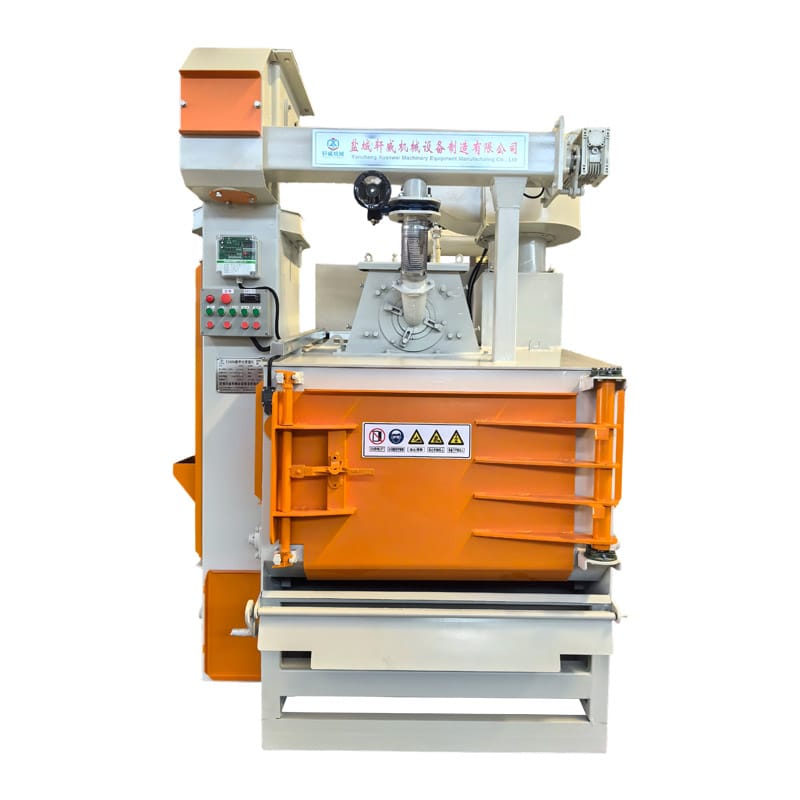
Production capacity can be expressed differently depending on machine design.
For batch equipment, it may refer to kilograms per batch, kilograms per hour, number of components per cycle, or another output measure.
For continuous machines, capacity may depend on conveyor speed, workpiece dimensions, spacing, surface condition, and required cleaning level.
A specification such as maximum hourly throughput should therefore be interpreted together with its operating assumptions.
Heavy rust or scale may require longer exposure than lightly oxidized material. Complex workpieces may also require slower movement to achieve complete surface coverage.
The most useful capacity figure is one based on workpieces similar to those used in actual production.
Conveyor Speed
Conveyor speed is particularly important for pass-through and continuous shot blasting machines.
The speed determines how long each section of the workpiece remains within the effective blasting zone.
If the conveyor runs too quickly, the abrasive may not have sufficient time to achieve the required surface condition. Slower travel increases exposure but reduces hourly throughput.
The optimum setting balances cleaning quality and production requirements.
Conveyor speed may be adjustable so the machine can process workpieces with different initial surface conditions.
When comparing specifications, manufacturers should determine whether the stated speed is fixed or variable and how it relates to the expected cleaning requirement.
Crawler Dimensions and Belt Type
For crawler machines, the dimensions and construction of the belt are important technical parameters.
The belt forms the working surface that supports and tumbles components during blasting.
Its dimensions influence batch volume, while the material and construction affect what types of workpieces can be processed.
The machine must allow sufficient movement for parts to rotate through the abrasive stream. Loading too many components into the available space can reduce tumbling efficiency even when the total batch weight is technically acceptable.
Crawler specification should therefore be evaluated together with loading volume, individual part size, and component geometry.
Chamber Dimensions
Blasting chamber dimensions define the primary internal working space.
However, buyers should distinguish between overall chamber dimensions and effective workpiece dimensions.
Internal liners, hooks, conveyor mechanisms, blast wheel projections, and workpiece movement can reduce the space actually available.
For rotating suspended parts, additional clearance is needed around the entire movement path.
For conveyor equipment, entrance and exit dimensions can be more relevant than overall chamber volume.
Effective working dimensions are therefore more useful than external cabinet dimensions when evaluating machine suitability.
Abrasive Storage Capacity
The abrasive storage hopper must contain enough reusable media to maintain stable circulation.
Storage capacity should correspond to abrasive flow and the overall size of the recovery system.
Insufficient media volume can cause unstable abrasive feeding, while excessive unnecessary storage adds little value if other parts of the circulation system cannot handle the same flow.
Operators should also consider how new abrasive is added and how operating mix is maintained over time.
As blasting media wears, a portion is removed by the separation system and must be replaced. Maintaining a suitable mixture of particle sizes contributes to consistent cleaning performance.
Bucket Elevator Capacity
The bucket elevator moves recovered abrasive vertically toward the separator.
Its capacity must exceed or adequately match the quantity of abrasive returning from the blasting chamber.
If the elevator cannot transport media quickly enough, abrasive may accumulate in the lower recovery system and reduce circulation stability.
The specification should therefore be considered together with total blast wheel abrasive flow.
Maintenance access is also important. Buckets, belts or chains, pulleys, bearings, and drive components operate continuously and are exposed to abrasive contamination.
A large nominal capacity provides little advantage if maintenance access is poor or the elevator is not properly matched to the rest of the system.
Separator Capacity
Separator performance is essential because recovered media contains reusable abrasive mixed with dust, rust, scale, and broken particles.
The separator must process the full return flow without allowing excessive contaminants to re-enter circulation.
Its capacity should therefore correspond to blast wheel abrasive consumption and elevator throughput.
Good separation supports a stable abrasive operating mix and prevents excessive fine particles from circulating through the wheel.
When evaluating shot blasting machine specifications, separator capacity should not be treated as a minor auxiliary number. It directly influences abrasive quality and long-term process consistency.
Dust Collection Air Volume
Dust extraction capacity is generally expressed as an airflow value.
The required volume depends on machine chamber size, abrasive flow, workpiece contamination, separator design, openings, and production intensity.
Insufficient airflow can allow excessive dust to remain within the machine and may affect visibility, separator performance, and internal cleanliness.
A very large dust collector is not automatically better either. The extraction system should be designed around the actual equipment and air-balance requirements.
Filter type, filtration area, cleaning system, duct arrangement, and maintenance access should be reviewed together with nominal airflow.
Total Installed Power
Total installed power represents the combined electrical load of the major machine systems.
This can include blast wheel motors, conveyors, crawler or hook drives, bucket elevators, screw conveyors, dust collection fans, and other auxiliary equipment.
It is different from blast wheel power alone.
Installed power helps factories plan electrical infrastructure, but it should not be used as the primary measure of machine performance.
Two machines with similar installed power can have very different workpiece capacities, blast arrangements, and handling systems.
Equipment efficiency should therefore be evaluated through the complete operating configuration rather than a single power figure.
Machine Overall Dimensions
Overall length, width, and height determine whether equipment can fit into the available factory space.
These shot blasting machine specifications are particularly important for continuous equipment, where loading and unloading conveyors can significantly increase the total installation footprint.
Hook equipment may also require sufficient overhead clearance for loading systems.
Machine dimensions alone do not represent the total required installation space. Maintenance access, electrical cabinets, dust collectors, ducts, abrasive loading areas, and operator movement should also be considered.
A practical layout should allow wear components to be inspected and replaced without requiring unnecessary disassembly of surrounding equipment.
Pit and Pitless Installation
Some shot blasting systems can be designed for pit or pitless installation depending on machine structure and factory requirements.
A pit may allow certain recovery components to sit below floor level, potentially simplifying workpiece movement through the machine.
Pitless designs can reduce civil construction requirements but may increase equipment height or require a different recovery arrangement.
The preferable option depends on factory conditions, workpiece handling, installation schedule, available ceiling height, and long-term maintenance access.
This decision should be made during equipment planning rather than after the machine layout has already been finalized.
Electrical Voltage and Frequency
Voltage and frequency are basic but important technical specifications for export equipment.
Electrical standards differ between regions, so the machine should be configured for the destination factory’s available power supply.
Motors, control components, transformers, and electrical protection should be selected accordingly.
Buyers should confirm voltage, phase, frequency, and relevant site conditions before manufacturing begins.
Changing an electrical configuration after equipment production can be more complicated than specifying the correct requirements at the beginning.
Noise and Operating Environment
Shot blasting equipment contains high-speed wheels, moving abrasive, conveyors, fans, and material-handling systems, all of which contribute to operating noise.
Although noise performance may not always appear prominently in a basic specification table, it should be considered when planning installation and operator access.
The surrounding environment also matters. Temperature, dust conditions, available ventilation, installation location, and working schedule may influence component selection and maintenance planning.
A technical specification should therefore describe the machine in the context of where and how it will operate.
Comparing Specifications Between Different Machine Types
Shot blasting machine specifications should not be compared directly when the machines use completely different handling principles.
For example, batch capacity is important for crawler equipment, while conveyor width and travel speed are more important for pass-through systems.
Hook load is critical for suspended equipment but irrelevant to mesh belt machinery.
A useful comparison should therefore focus on parameters appropriate to each machine type.
| Machine Type | Most Important Specifications |
|---|---|
| Crawler | Batch load, part size, crawler dimensions, wheel power |
| Hook | Hook load, rotating diameter, chamber size, wheel arrangement |
| Roller conveyor | Passage size, conveyor speed, workpiece load, wheel layout |
| Overhead conveyor | Hanger load, line speed, spacing, wheel arrangement |
| Mesh belt | Belt width, loading, line speed, workpiece dimensions |
This approach prevents misleading comparisons between machines designed for fundamentally different production requirements.
Specifications That Should Come From the Workpiece
The most reliable machine specifications begin with actual production data.
Before equipment selection, manufacturers should prepare maximum and minimum workpiece dimensions, individual weight, batch weight, hourly output requirement, material type, surface contamination, and desired cleaning result.
It is also useful to determine whether parts can contact each other during blasting and whether they require rotation, tumbling, or continuous transport.
Photographs, technical drawings, and representative samples can provide additional information about geometry and areas that may be difficult for abrasive to reach.
From this information, chamber dimensions, wheel configuration, handling capacity, conveyor speed, abrasive flow, and dust collection requirements can be developed more accurately.
Common Specification Comparison Mistakes
One common mistake is choosing the machine with the highest motor power without considering blast pattern or workpiece movement.
Another is comparing chamber size while ignoring effective working clearance.
Manufacturers may also focus on maximum throughput even when the quoted capacity is based on a different workpiece condition from their own production.
Abrasive recovery and dust collection specifications are sometimes overlooked because they do not directly appear to clean the workpiece. In reality, both systems have a significant influence on stable long-term operation.
Another mistake is designing the equipment only around the current average workpiece. Maximum dimensions, heavier future components, and realistic production variation should also be considered where appropriate.
Building a Shot Blasting Machine Specification Sheet
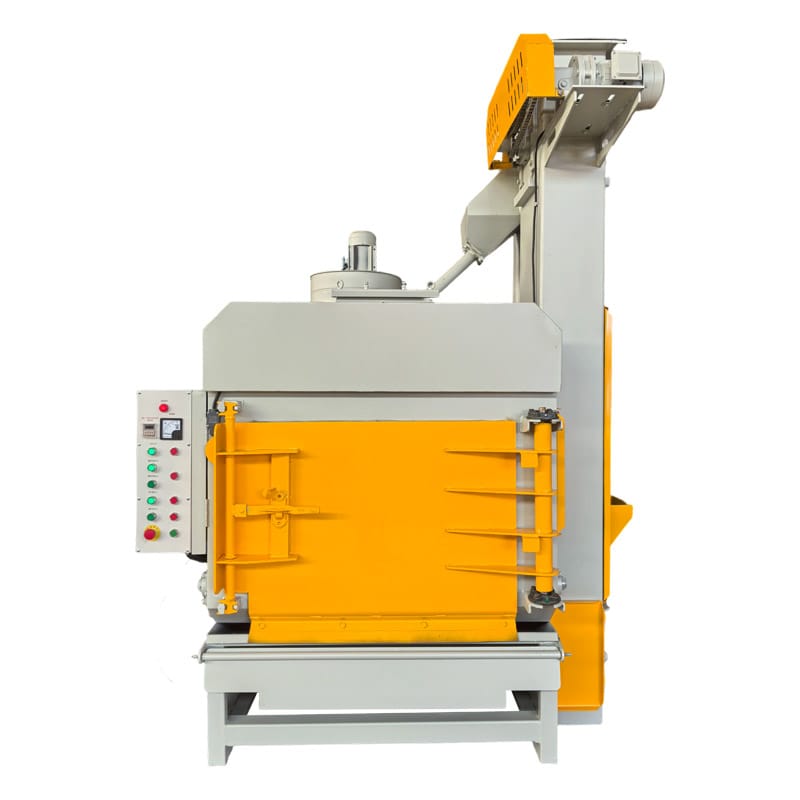
A practical specification sheet should begin with workpiece information rather than machine parameters.
The first section should identify dimensions, weights, material, production quantity, and surface condition.
The second should define the required handling method, such as tumbling, hook rotation, roller transport, or belt transport.
The blasting system can then be specified according to wheel quantity, wheel power, abrasive flow, and expected coverage.
Abrasive recovery, separation, dust extraction, controls, electrical requirements, overall dimensions, and installation conditions should complete the document.
Organizing specifications in this sequence helps ensure that machine design follows actual production needs.
Conclusion
Shot blasting machine specifications should be evaluated as an interconnected technical system rather than a collection of independent numbers.
Workpiece dimensions and weight determine basic handling requirements. Blast wheel quantity, power, abrasive flow, and positioning influence cleaning capability. Conveyor speed or batch capacity determines production flow, while recovery, separation, and dust extraction support stable operation.
Overall dimensions, installed power, electrical configuration, and installation requirements then determine how the equipment fits into the factory environment.
The most suitable machine is therefore not necessarily the one with the largest chamber or highest power rating. It is the configuration whose specifications are properly matched to the workpiece, surface requirement, production target, and operating conditions.
FAQ
Which shot blasting machine specifications are most important?
The most important specifications include workpiece dimensions and weight, batch or conveyor capacity, blast wheel quantity and power, abrasive flow, handling speed, dust extraction, and machine dimensions. These parameters should be evaluated together because each one influences cleaning performance and production capability.
Does higher blast wheel power always provide better cleaning?
No. Higher wheel power can increase available blasting energy, but cleaning also depends on abrasive flow, blast pattern, wheel position, workpiece movement, media condition, and exposure time. A correctly configured lower-power system can outperform a higher-power machine if abrasive coverage is better matched to the workpiece.
How should production capacity be compared between machines?
Production capacity should be compared using workpieces and surface conditions similar to actual production. Batch weight, cycle time, conveyor speed, loading time, workpiece spacing, and required cleaning level all affect real throughput. A single maximum-capacity figure may not represent normal factory operating conditions.
Why is dust collector airflow included in machine specifications?
Dust collector airflow affects the removal of airborne fines generated during blasting and abrasive separation. The correct airflow helps maintain stable internal conditions and supports media separation. Capacity should be matched to chamber size, abrasive circulation, workpiece contamination, and overall equipment configuration.
What information should be provided before machine specifications are finalized?
Manufacturers should provide workpiece drawings, maximum and minimum dimensions, individual and batch weight, material type, initial surface condition, required cleaning result, production target, and preferred handling method. Factory layout, electrical supply, installation conditions, and maintenance access should also be considered.